Bhagya M. Subrayan(she/her/hers)
Postdoctoral Researcher · Steward Observatory, University of Arizona
“Each one of you can change the world, for you are made of star stuff, and you are connected to the universe.”
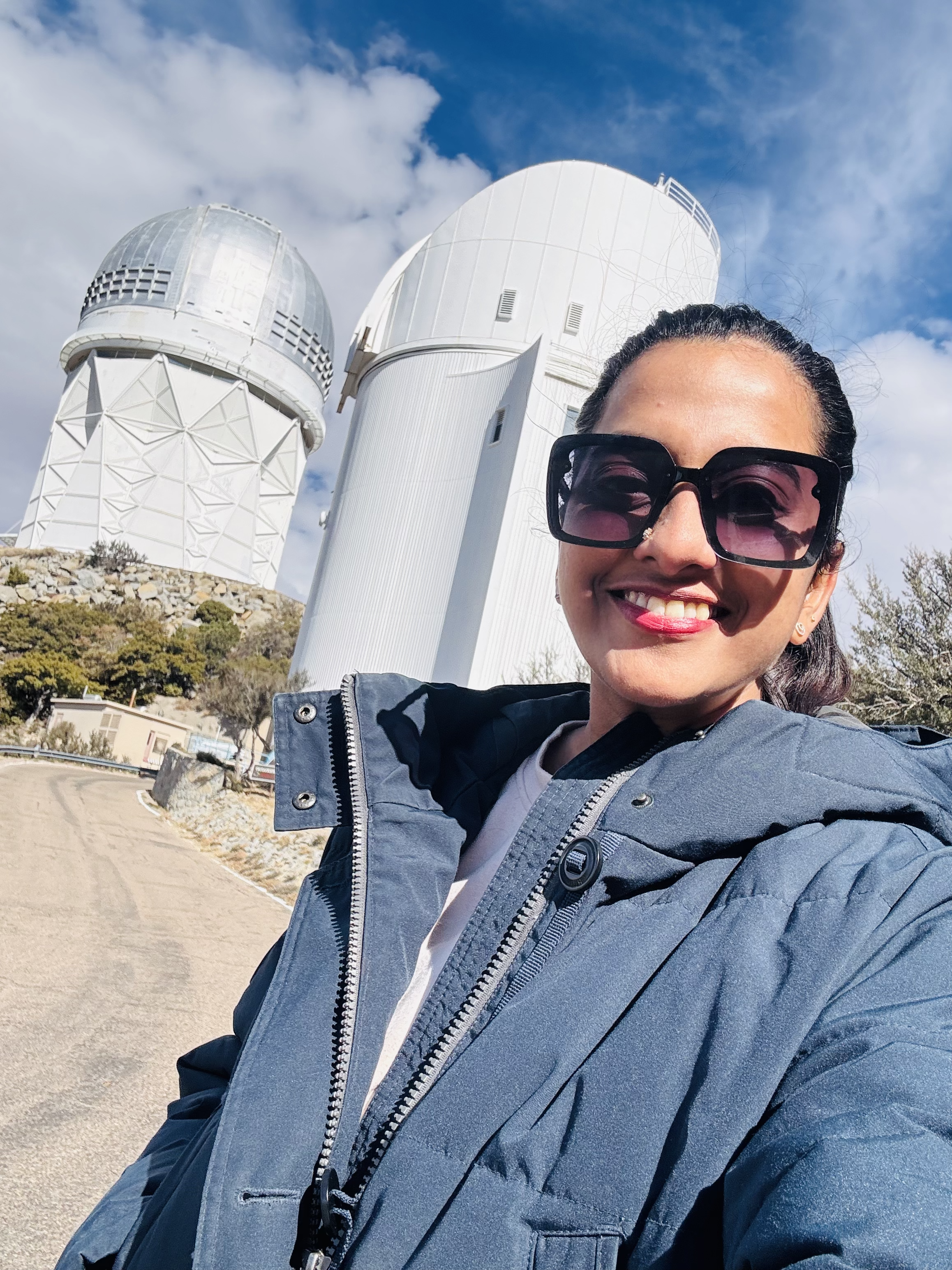
Kitt Peak National Observatory (KPNO) Tucson, Arizona
Hello! Hola! നമസ്കാരം!
I am a postdoc at Steward Observatory, University of Arizona, working with Prof. David J. Sand. My research follows core-collapse supernovae from their first hours to thousands of days after explosion: I use the James Webb Space Telescope to watch cold dust condense in supernova ejecta, chase the earliest light from very young nearby transients, and search for the electromagnetic counterparts of gravitational-wave events with Arizona's telescopes.
I completed my Ph.D. in Physics and Astronomy at Purdue University with Dr. Danny Milisavljevic, where I built statistical inference machinery to pull explosion parameters out of sparse all-sky survey light curves, and helped develop REFITT, an AI system that recommends which transients to follow up, and when. Along the way I led the discovery paper on AT 2021lwx, better known as “Scary Barbie,” one of the most energetic non-quasar optical transients ever recorded, now belonging to the class called Extreme Nuclear Transients (ENTs).
Beyond my academic work, I’m passionate about programming, data science , and the application of machine learning in astronomy. I’m also a strong advocate for women and underrepresented groups in STEM , and I take pride in participating in leadership roles that promote diversity and inclusion in science. I spent three
years with Purdue's
Women in Science Program
and served as president of the Physics Graduate Student Association, and I now
mentor undergraduate and graduate students on projects of their own.
Feel free to explore my work or reach out if you’re interested in collaborating!
Timeline
Steward Observatory, University of Arizona, Tucson, USA. Advisor: Prof. David J. Sand.
Purdue University, West Lafayette, USA. Advisor: Prof. Danny Milisavljevic. Thesis: Constraining explosion physics and progenitors of transients via statistical inferencing of all-sky survey data streams.
Indian Institute of Science Education and Research (IISER), India. Minor in Chemistry.
What I work on
- Multi-wavelength observations of astrophysical transients in time-domain astronomy
- Extreme Nuclear Transients
- Electromagnetic counterparts of gravitational-wave events
- Dust reservoirs and mass-loss mechanisms in massive stars
- Early photometric and spectroscopic observations of young transients
- Maximising the scientific return of all-sky surveys with new technologies
Current research projects
Search for the host galaxy of the Extreme Nuclear Transient AT 2021lwx
Search for the elusive host galaxy of the extreme nuclear transient AT 2021lwx, using deep HST and JWST imaging to uncover its faint environment and shed light on the nature and origin of this extraordinary transient.
Read more →Dust in core-collapse supernovae
A JWST/MIRI sample of eleven normal Type IIP supernovae spanning 400–2300 days, asking when and how much dust ordinary explosions make. Can normal CCSNe produce dust to account for the dust we see in the early Unierse?
Read more →Early Observations of Supernovae
Early observations of very young supernovae like the Type IIb SN 2024uwq that constrain can be used to constrain the progenitor star that exploded. The bigger question is to answer what stars explode as what type of supernovae? How can early observations of the explosion help us understand these systems better?
Read more →Gravitational-wave follow-up in search of electromagnetic (EM) counterparts
Leading MMT and Magellan follow-up of LIGO–Virgo–KAGRA (LVK) GW alerts with SAGUARO, and building the vetting tools that tell a kilonova apart from the supernovae crowding the same sky.
Read more →Science-Driven Recommendations and Follow-up of Transient from All Sky Surveys
Developing science-driven strategies to identify, prioritize, and follow up transients discovered across wide-field sky surveys, enabling rapid characterization of the most interesting and anomalous events.
Read more →News & highlights
- August 2026 Submitted lead author “A JWST/MIRI Study of Dust in a Sample of Normal Type IIP Core Collapse Supernovae” to arXiv (arXiv:2608.16979) and the AstrophysicaL Journal.
- June 2026 Awarded NASA-Keck time as PI (Program N172) with LRIS-ADC to study late-time signatures of CSM interaction and dust formation in core-collapse supernovae.
- May 2026 Invited talk at the ASU Spring 2026 Workshop on Multi-Messenger Astrophysics.
- 2026 Awarded JWST Cycle 5 program GO-11424 as PI, to resolve the host galaxy of the extreme nuclear transient AT 2021lwx and test black-hole–host scaling relations.
- January 2026 Olivia Culbert, the undergraduate I mentor at Arizona, was a Chambliss Award finalist at AAS 247 in Phoenix for our work on dust in normal core-collapse supernovae.
- December 2025 Awarded Gemini-N/S time (GN-2026A-Q-124; GS-2026A-Q-120) in 2026A as PI for late-time signatures of CSM interaction and dust formation in normal CCSNe.
- August 2025 First-author ApJL on shock-cooling emission in the Type IIb SN 2024uwq, placing constraints on the supernova progenitor.
- May 2025 Cycle 32 HST Observations of AT 2021lwx aka "Scary Barbie" completed (PI: Subrayan, ID: 17748).
Off the telescope
I am a South Indian from Kerala, and a lot of what grounds me is unglamorous and boring: outdoor runs, volleyball, lifting, creating video logs and cooking for people. I am passionate traveler and travel whenever the schedule lets me. I believe traveling is a sole privilege and I am grateful for it.
I also enjoy the science-communication side of this job more than I expected to. Explaining an extra ordinarily luminous event on NPR's 1A to an audience with no astronomy background was one of the more useful things I have done for my own thinking. More of that on the outreach page.
Contact
University of Arizona
933 North Cherry Avenue
Tucson, AZ 85719
bsubrayan@arizona.edu
I am always glad to hear from people interested in collaborating on young transients, supernova dust, or multi-messenger follow-up and from students looking for a project.
“Email me” opens your own mail app; use the Gmail link if you read mail in a browser.